
Fat Grafting in Breast Reconstruction: Refining Shape and Contour
Fat grafting in breast reconstruction is a refinement step. I take a small amount of your own fat from another area, such as the abdomen or thighs, and place it where the reconstructed breast needs softening, filling or smoothing. It is usually done as a later stage, after the main implant or flap reconstruction has healed, and it is meant to improve shape and contour rather than create a new breast on its own.
I have been performing breast reconstruction since 2008. Many women reach this point and wonder whether fat transfer after mastectomy is something they should consider. In this article, I want to walk you through where it can fit, what it can and can’t do, and what to ask me when we meet. Please treat this as general education, not medical advice for your individual situation.
Why is breast reconstruction often done in stages?
Breast reconstruction is rarely a single operation. The first stage builds the foundation. For many women that means tissue expanders that are later replaced with implants. For others it means reconstruction using their own tissue, often called flap reconstruction. After that first stage, your body needs time to heal and settle.
As swelling goes down, small differences often become easier to see. You might notice a slight hollow near the top of the breast, a visible implant edge, a dip along a scar, or a difference between the two sides. This is common, and it is one reason reconstruction is planned in stages.
Later stages are where we refine. Refinement might happen at the time of tissue expander exchange surgery, or as a separate procedure after you have healed. Fat grafting is one of the tools I may suggest at this point. It is not right for everyone, and it is not required. For some women, though, it can help the reconstructed breast look and feel more natural.
What is fat grafting, in brief?
Fat grafting, also called fat transfer, moves fat from one part of your body to another. I’ve covered the basics in what is fat grafting, so I won’t repeat them here.
In short, fat is gently removed with liposuction, prepared, and then placed in small amounts where it’s needed. The same technique is also used in cosmetic procedures, which you can read about on my fat grafting in Phoenix page. This article focuses only on how fat grafting is used during breast reconstruction.
How can fat grafting in breast reconstruction smooth contour?
The goal of fat grafting after breast reconstruction is refinement. Depending on your situation, it may be used to:
- Soften a visible implant edge or rippling under thin skin.
- Fill a hollow, often in the upper part of the breast or along the chest wall.
- Smooth a dip or irregularity in a flap reconstruction or near scars.
- Help balance small differences between the two sides.
Because the fat is your own tissue, no foreign material is added in this step. It is placed in small amounts and in layers, which is why the changes tend to be subtle. That is what I aim for: natural looking and aesthetically pleasing results, not a dramatic transformation.
It also helps to know what fat grafting usually can’t do. It generally isn’t a way to make a large change in size, and for most women it doesn’t replace the main reconstruction. If your concern is the position of an implant or a larger asymmetry, a different type of revision may make more sense. I will tell you that honestly.
What do the process and recovery generally involve?
Every patient is different, so please read this as an overview rather than a plan for you.
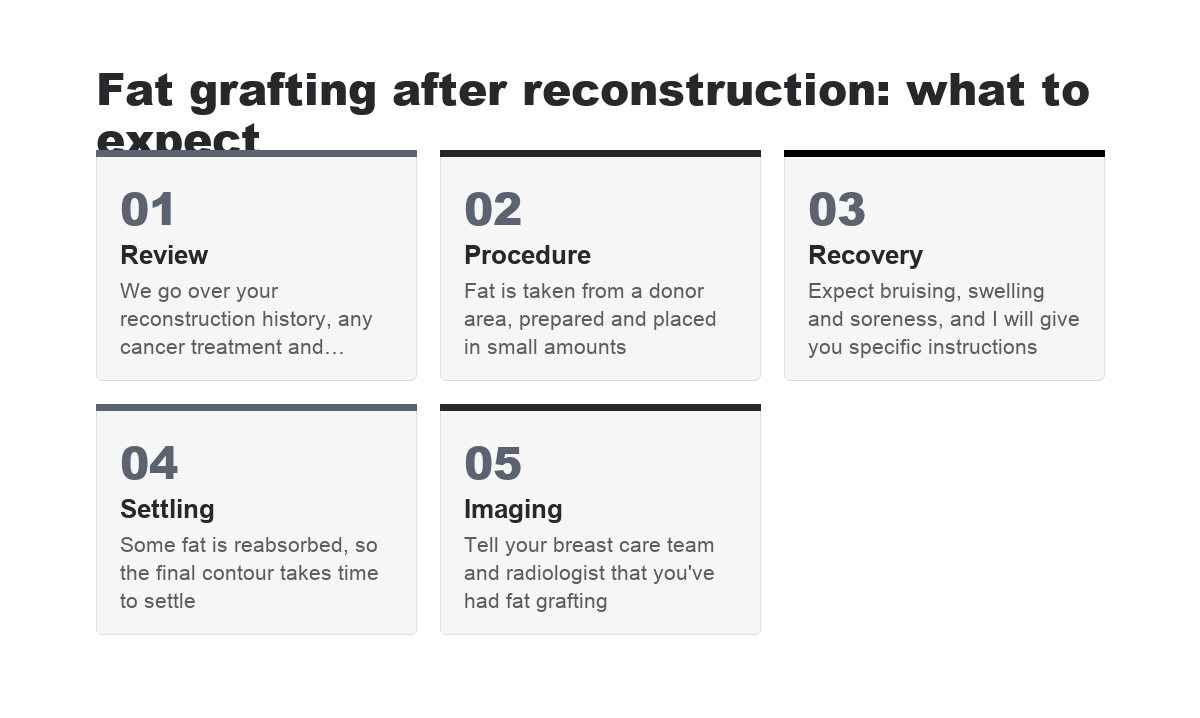
- Before: We review your reconstruction history, any radiation or other cancer treatment, and your overall health. I coordinate with your cancer care team as needed.
- The procedure: Fat is taken from an area with enough to spare, commonly the abdomen, flanks or thighs. It is then prepared and placed into the breast. I’ll explain the type of anesthesia and the setting that apply to you.
- Recovery: Expect bruising, swelling and soreness both where the fat was taken and in the breast. Many patients wear compression over the donor area for a period. I’ll give you specific instructions about activity and returning to your normal routine.
- Over time: The body doesn’t keep all of the transferred fat, and some is reabsorbed as you heal. The final contour therefore takes time to settle, and some patients choose more than one session.
- Breast imaging: Fat grafting can cause changes that show up on breast imaging, such as small firm areas or calcifications. Let your breast care team and radiologist know you’ve had fat grafting so they can read your imaging with that in mind.
Any surgery carries risks. With fat grafting these include infection, firm lumps where fat doesn’t survive, contour irregularity, and the risks of anesthesia. We will talk through these one-on-one before you decide anything.
Is fat grafting a good next step for me? A simple way to decide
Here is a rule of thumb that can help you frame the conversation. If your concern is a localized area, such as a hollow, a visible edge or a dip, fat grafting is worth asking about. If your concern is overall size or implant position, we’ll likely discuss other options as well.
One important exception: a change you notice suddenly is not a refinement question. New pain, swelling, redness or a new lump should be reported to your care team right away rather than saved for a cosmetic follow-up.
Timing matters too. I generally prefer to wait until your tissues have healed and settled so we can see the true contour. If you have had radiation, I’ll factor that into the plan and the timing.
Questions to ask me at your consultation
Every procedure starts with a one-on-one consultation with me. I want you to feel comfortable asking anything. Here are some questions worth bringing:
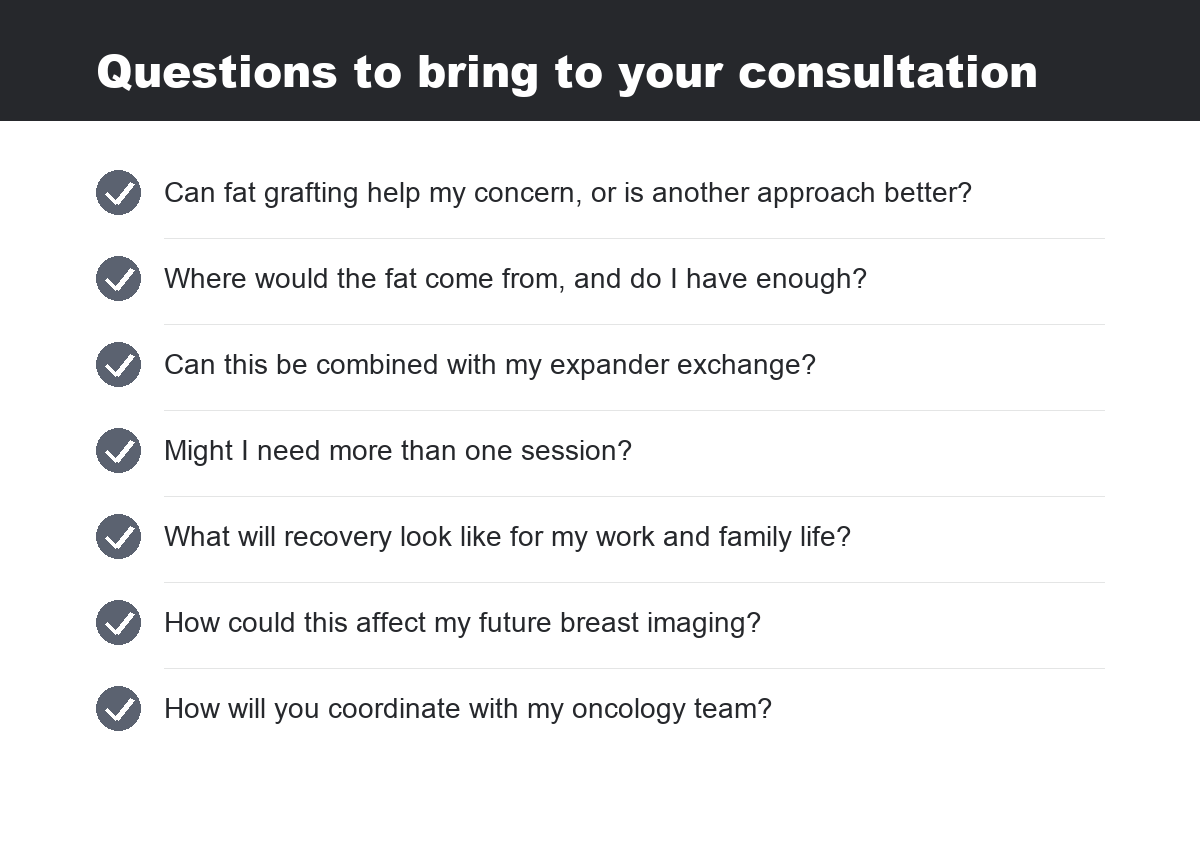
- Is my concern something fat grafting can help, or would another approach work better?
- Where would the fat come from, and do I have enough?
- Can this be combined with my expander exchange or another planned stage?
- Might I need more than one session?
- What will recovery look like for my work and family life?
- How could this affect my future breast imaging?
- How will you coordinate with my oncology team?
I believe in education before decisions. My goal is a relaxed, worry free environment where you can take your time, and your safety and comfort will always be my first priority. You are welcome to bring someone with you for support.
My free Complete Guide to Understanding Breast Reconstruction
If you’re early in the process, or you’d like everything in one place to read at your own pace, download my free Complete Guide to Understanding Breast Reconstruction. It’s a helpful starting point before we meet. You can also learn more about my approach to breast reconstruction in Phoenix.
I am a Double Board Certified Plastic Surgeon and a female plastic surgeon, with offices in Phoenix and Chandler. Reconstruction is personal. I want to help you be who you were before, and to feel confident in your own body again.
Frequently Asked Questions
Is fat grafting a separate surgery from my breast reconstruction?
It can be. Fat grafting is often done as a later refinement stage. Sometimes it can be combined with another planned step, such as tissue expander exchange surgery. We’ll decide what makes sense for you at your consultation.
Will I need more than one fat grafting session?
Some patients do. The body reabsorbs part of the transferred fat as it heals, so the final contour takes time to settle, and some women choose an additional session. I can’t predict this in advance for any one person, and we’ll discuss it openly.
Does fat grafting affect mammograms or other breast imaging?
Fat grafting can create changes that appear on breast imaging, such as small firm areas or calcifications. Tell your breast care team and radiologist that you’ve had fat grafting so they can interpret your imaging correctly.
Can fat grafting be used with both implant and flap reconstruction?
Fat grafting can be used to refine contour in both implant-based and flap reconstruction. Whether it’s a good fit for you depends on your tissues, your treatment history and your goals, which we’ll review together one-on-one.
If you’re partway through reconstruction and wondering about next steps, I’m here to help. Call (480) 963-3034 for a one-on-one consultation, or download my free Complete Guide to Understanding Breast Reconstruction.
